International Center for Interfaith and Interreligious Dialogue and Pakistani University of Narowal Strengthen Strategic Ties
Narowal, May 3, 2026.
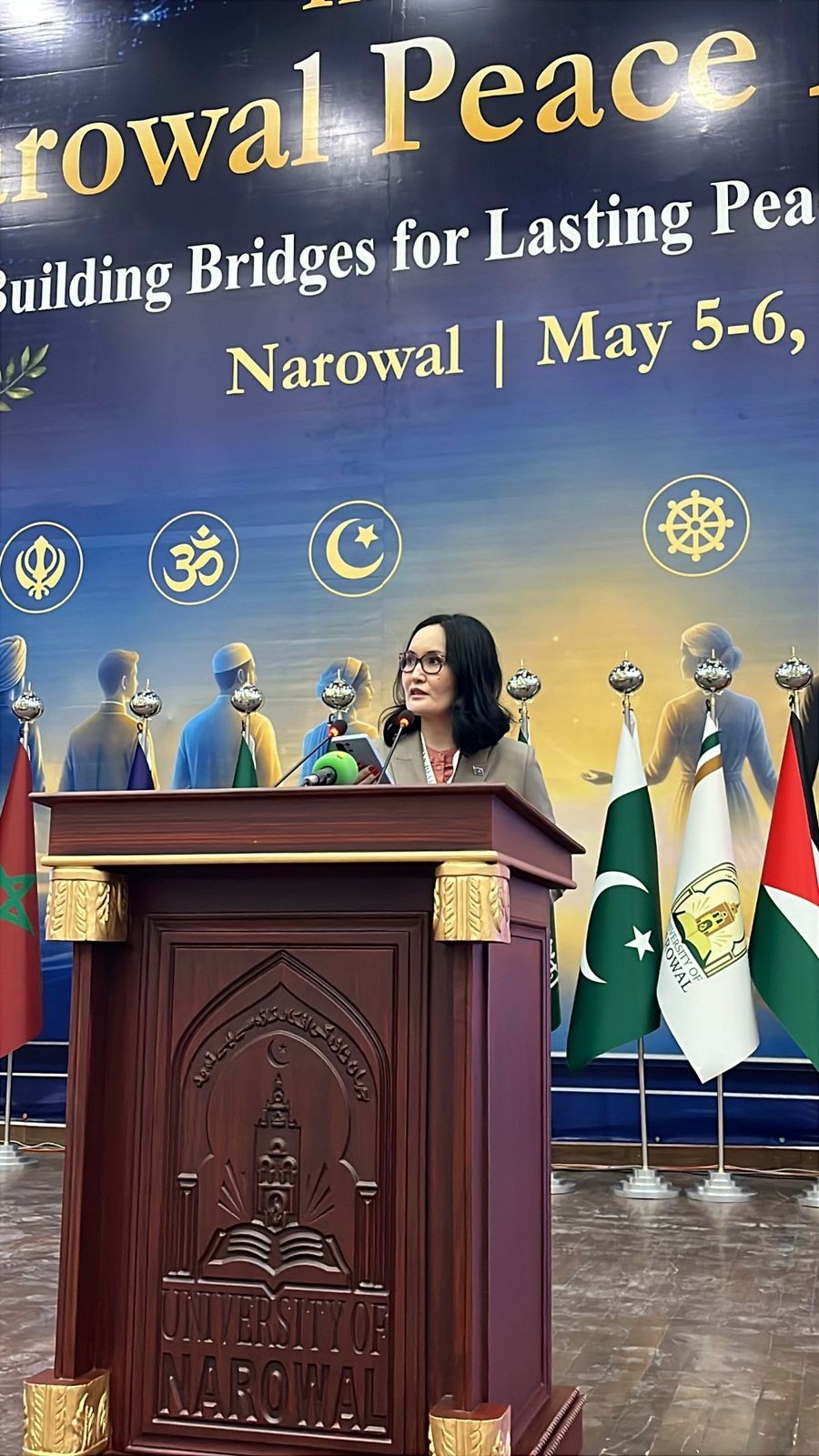
The International Center for Interfaith and Interreligious Dialogue (ICIID) participated in the II Narowal Peace Dialogue held at the University of Narowal in Pakistan. The event brought together leading political figures, scholars, and religious leaders from Pakistan, Tunisia, Jordan, the United States, and other nations to formulate new approaches to global harmony by bridging civil and academic institutions.
During her address, Gulsana Kozhabay, Chair of the Board of ICIID, presented a vision of dialogue as a deliberate process requiring institutional resilience and patience. She argued that the primary mission of this work is to prevent cultural differences from transforming into deep social fractures. She emphasized that the value of the Congress of Leaders of World and Traditional Religions lies in its continuity—from its first steps in 2003 to the adoption of the Astana Peace Declaration in 2025. This sustained approach has allowed the Congress to become a unique space where common moral ground is preserved even during periods of acute global polarization.
The discussion highlighted that the platforms in Astana and Narowal are inherently complementary. Leveraging the Congress’s twenty-year legacy as a bridge between civilizations, ICIID is currently working to translate accumulated spiritual experience and the wisdom of faith into practical solutions for global challenges. This effort is reflected in the Congress’s current initiatives, including the development of ethical frameworks for artificial intelligence and the role of religion in combating climate change.
In his remarks, Ahsan Iqbal, Pakistan’s Minister for Planning, Development, and Special Initiatives, described the Narowal Peace Dialogue as an act of defiance against violence, born from his personal experience of an assassination attempt. Reflecting the Chair’s focus on social cohesion, he noted that true development cannot be built on a foundation of fear and that the primary task is to nurture the youth as “ambassadors of peace” equipped with critical thinking. For the Minister, dialogue is a moral and civilizational duty that allows differences to be transformed into a foundation for cooperation rather than hatred.
Vice-Chancellor Professor Dr. Muhammad Zia-ul-Haq represented the University of Narowal at the event. Speaking as both a member of the Congress Working Group and its Goodwill Ambassador, he commended Kazakhstan’s peacemaking initiatives and noted that the Pakistani academic community is ready to contribute to the analytical work of ICIID and participate in its Expert Roundtable.
The discussion also featured former Prime Minister of Morocco Saad Dine El Otmani and the Ambassador of Kazakhstan to Pakistan Yerzhan Kistafin. The Ambassador highlighted the partnership between Astana and Islamabad, noting that security and regional dialogue serve as engines for peace, which is inseparable from progress. In turn, El Otmani identified unity and the recognition of diversity as key to the region's survival. He emphasized the importance of treating others with kindness and respect, noting that peace is achieved not through violence, but through empathy and knowledge.
The event concluded with the signing of a Memorandum of Understanding, establishing a basis for long-term partnership and joint projects. Gulsana Kozhabay invited the Pakistani delegation to participate in key Congress initiatives, including the engagement of Pakistani youth in the Young Religious Leaders Forum scheduled for 2028 in Astana.