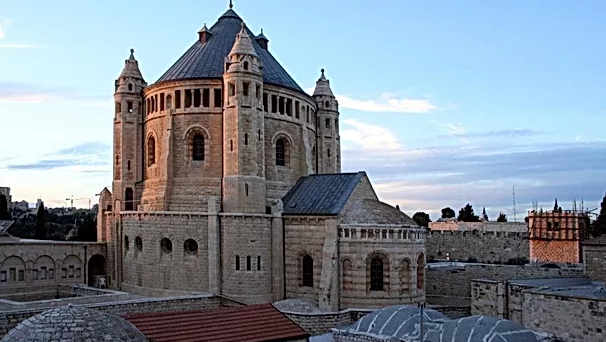
Dormition Abbey, Israel
Brief Description
The Dormition Abbey (Abbey of the Dormition of the Virgin Mary) is a Catholic Benedictine monastery located on Mount Zion in Jerusalem, built in the early 20th century on the site where, according to Christian tradition, the Blessed Virgin Mary completed her earthly life. It is one of the most important Christian sanctuaries in the Holy Land, renowned for its crypt containing a statue of the Sleeping Virgin, its rich mosaics, and its cultural role as a center of pilgrimage and inter-Christian dialogue.
Location
The Dormition Abbey, also known as the Abbey of the Dormition of the Virgin Mary, is situated on Mount Zion in Jerusalem, near the Zion Gate of the Old City. It was built on the site where, according to ancient Christian tradition, the Virgin Mary ended her earthly life and was taken up to heaven. This location is one of the most venerated Christian sites in the Holy Land.
Historical Background
Located in the southwestern part of the Old City of Jerusalem, on Mount Zion, the Dormition Abbey—officially known as the Abbey of the Holy Virgin Mary on Mount Zion—has roots tracing back to the Byzantine period. The first churches dedicated to the Dormition of the Virgin appeared here as early as the 4th–5th centuries. In the Middle Ages, the “Holy Zion” basilica stood on this site and was considered one of the most important sanctuaries of Jerusalem.
After centuries of destruction and abandonment, the site was revived at the end of the 19th century, when German Emperor Wilhelm II purchased the land from the Ottoman Sultan and initiated the construction of a new monastery. The project was designed by Heinrich Renard and supervised by Theodor Sandel. Construction began in 1900 and continued for ten years; the first Benedictine monks settled there in 1906.
According to tradition, this is the place where the Virgin Mary spent her final years under the care of John the Theologian, and from where she was accompanied on her final journey. In the 5th century, a church dedicated to the Descent of the Holy Spirit at Pentecost was built on this site; it stood for five centuries before being destroyed. The Crusaders later reconstructed it, but it was again demolished in 1200. When Wilhelm II visited Jerusalem in 1898 for the consecration of the Protestant Church of the Redeemer, he purchased the ruins of the ancient church site and gifted the land to the Benedictine order, who built the present-day abbey.
Religious Significance
The religious importance of the Dormition Abbey is immense, as according to ancient Christian belief, this is the place where the Blessed Virgin Mary “fell asleep” (dormitio) and completed her earthly journey. In the crypt of the monastery lies a statue of the Sleeping Virgin, symbolizing her peaceful passing. For millions of Christians worldwide, this site is one of the most sacred places connected with the life of the Mother of Jesus Christ.
The abbey is a center of celebration of the Feast of the Dormition, one of the principal feasts of the Christian liturgical calendar. Special services and processions take place here, attracting pilgrims of different denominations from around the world. The site holds significance for both Catholics (as a Benedictine monastery) and Orthodox Christians, who also venerate Jerusalem as the place of the Virgin’s Dormition.
According to apocryphal writings and Church tradition, after the Virgin’s death, the Apostles gathered in Jerusalem to bid her farewell. Three days later, when her tomb was opened, her body was gone—believers took this as a sign that she had been assumed into heaven. Another legend tells that, at the moment of her passing, a heavenly light filled the place, and the Apostles were miraculously transported from distant lands to witness her peaceful departure. This story symbolizes Mary’s eternal intercession and protection over all believers.
Cultural and Tourist Significance
The Dormition Abbey is not only a major religious center but also a cultural and architectural landmark of Jerusalem. Built by German Benedictines in the early 20th century, it stands out with its massive dome and twin towers, dominating the skyline of Mount Zion. The interior is adorned with Romanesque-Byzantine mosaics, stained glass, and icons, depicting scenes from the life of the Virgin Mary.
The crypt is one of the main attractions for visitors: it contains a sculpture of the Sleeping Virgin Mary, made of ivory and wood, symbolizing her dormition. Surrounding the statue are six colorful altars, each representing different countries—Venezuela, Austria, the USA, Brazil, Côte d’Ivoire, and Hungary. The church floor is decorated with a mosaic of prophets and apostles.
The abbey is also known for its exceptional acoustics, and its main hall hosts sacred and classical music concerts, making it both a spiritual and cultural venue. Its architectural blend of Byzantine and Islamic styles gives the monastery a unique aesthetic appeal.
For tourists and pilgrims, the Dormition Abbey is an essential stop on the pilgrimage route through the Holy Land, located near the Cenacle (the Room of the Last Supper), the Church of St. Peter in Gallicantu, and the Church of the Holy Sepulchre.
In addition, the abbey serves as a venue for interfaith and intercultural dialogue—hosting conferences, prayers, and meetings that promote understanding among Christians of various denominations. In contemporary Jerusalem, it stands as a symbol of peace, unity, and openness.
Current Status
Today, the Dormition Abbey remains an active Benedictine monastery. Regular liturgical services, spiritual concerts, and cultural events are held here. Each year, tens of thousands of pilgrims and tourists visit the site.
Due to its location on Mount Zion, it is an integral part of Jerusalem’s pilgrimage route, connecting key holy sites such as the Tomb of the Virgin Mary, the Cenacle, and the Church of St. Peter in Gallicantu. The abbey continues to serve as a living center of faith, history, and dialogue in the heart of the Holy City.