The Cenacle (Upper Room of the Last Supper), Israel
Brief Description
The Cenacle (Upper Room of the Last Supper), located on Mount Zion in Jerusalem, is considered one of the holiest sites in the Christian world. According to the Gospel tradition, this is the place where Jesus Christ gathered His apostles for the Last Supper on the night before His Passion. During this meal, Christ instituted the Sacrament of the Eucharist, giving His disciples bread and wine as His Body and Blood with the words: “Do this in remembrance of Me.” This moment marks the beginning of the liturgical tradition of the Christian Church.
Location
The Cenacle is situated in Jerusalem, on Mount Zion, near the Zion Gate of the Old City. It lies only a few hundred meters from the Western Wall and the Church of the Holy Sepulchre, in the very heart of an area rich with sacred sites of the three major world religions.
The building of the Cenacle is part of a complex that also includes the Tomb of King David, located on the lower level. This unique proximity highlights the interreligious character of the site – it is simultaneously connected to Jewish, Christian, and Muslim traditions.
Its closeness to other holy places makes the Cenacle one of the key points on the pilgrimage route through Jerusalem. It is easily accessible through the Zion Gate and has long been a significant center of the city’s spiritual and cultural life.
Historical Background
The history of the Cenacle dates back to the earliest centuries of Christianity. As early as the 1st–2nd centuries, it was venerated as the place where the apostles gathered after the Resurrection of Christ. It is also believed to be the site of one of the most important events in Christian history – the Descent of the Holy Spirit on the day of Pentecost. According to tradition, the apostles were in this room with the Blessed Virgin Mary when the Holy Spirit descended upon them in the form of tongues of fire. This event is considered the birth of the Church.
In the 4th century, the Byzantines built the first Basilica of Holy Zion here, known as Mater omnium ecclesiarum (“Mother of all Churches”). It was destroyed in the 7th century. During the Crusader period, a new church was built on the same site, but it too was later damaged after the fall of Jerusalem. The current building dates back to the 14th century and has preserved elements of Gothic Crusader architecture.
Religious Significance
The religious importance of the Cenacle cannot be overstated – it is one of the holiest Christian sites in the world. According to tradition, it was here that Jesus Christ, on the night before His Passion, celebrated the Last Supper with His disciples, instituting the Eucharist. From this moment, the liturgical life of the Church began, and every Christian worship service commemorates the Last Supper.
Furthermore, according to the Acts of the Apostles, this was the place where the Holy Spirit descended upon the apostles on the day of Pentecost. This event marked the birth of the Church: the apostles received power and the gift of speaking in different tongues to preach the Gospel to all nations. Thus, the Cenacle symbolizes the beginning of the Church’s mission and the spiritual unity of Christians.
Tradition also holds that the apostles gathered here after Christ’s Resurrection, that the election of Matthias to replace Judas Iscariot took place here, and that the Blessed Virgin Mary prayed in this room with the disciples. The Cenacle is therefore revered as the place where the early Christian community was formed.
Interestingly, the building also carries interreligious significance: the lower floor is revered by Jews as the Tomb of King David, and for Muslims, Jerusalem and Mount Zion are also part of sacred history. Because of this, the Cenacle is perceived not only as a Christian shrine but also as a meeting point of three religions.
For Christians worldwide, the Cenacle remains the “Cradle of the Church” – a place where the memory of Christ, the action of the Holy Spirit, and the prayers of the apostles come together, making it one of the most profound symbols of faith.
Cultural and Touristic Significance
The Cenacle’s cultural and touristic significance extends far beyond its religious role. Closely tied to key events in Christian history, it has become one of the most important shrines of the Holy Land. Every year, millions of pilgrims and tourists visit Jerusalem to enter the room where Christ is believed to have instituted the Eucharist and where the Holy Spirit descended upon the apostles.
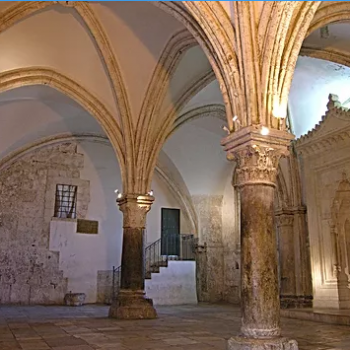
Architecturally, the Cenacle represents a unique blend of styles. The present structure, built in the 14th century by Crusaders, retains elements of Gothic design – pointed arches, vaulted ceilings, and carved capitals. At the same time, Arabic motifs were added during the Ottoman period, making the site an architectural fusion of European and Eastern traditions.
The building’s interreligious importance adds further cultural value. The lower level is venerated by Jews as the Tomb of King David, while the upper level is sacred to Christians. This makes the Cenacle a rare site of convergence between Judaism, Christianity, and Islam – a symbol of interfaith dialogue and coexistence.
For tourists, the Cenacle is a must-see destination in Jerusalem. It stands close to other key religious sites such as the Dormition Abbey, the Chamber of the Apostles, and the Church of St. Peter in Gallicantu. Together, these locations form an essential part of the city’s pilgrimage routes.
Current Status
Today, the Cenacle remains one of the main Christian holy sites in Jerusalem, open to pilgrims and tourists from around the world. It is under the protection of the State of Israel and is included in the list of the Old City’s cultural and historical heritage sites. The building is regularly restored to preserve its 14th-century architectural elements, including its Gothic vaults and carved details.
The upper room is used by Christians for worship and prayer gatherings, especially during Easter and Pentecost. During these festivals, pilgrims of various denominations gather to pray in the place where Christ is believed to have held the Last Supper and where the apostles received the Holy Spirit. The lower floor continues to be venerated by Jews as the Tomb of King David, giving the site special interreligious significance.
The Cenacle’s current state reflects its unique role as a space where different faiths and cultures meet. Despite disputes over ownership and occasional access restrictions, the Cenacle remains open to visitors and is an essential part of Jerusalem’s religious and cultural landscape.
For visitors, the site offers convenient access, guided tours, and opportunities for prayer and worship. The Cenacle continues to serve not only as a place of deep spiritual power but also as a symbol of cultural dialogue – a living monument that unites past and present.