Brief Description
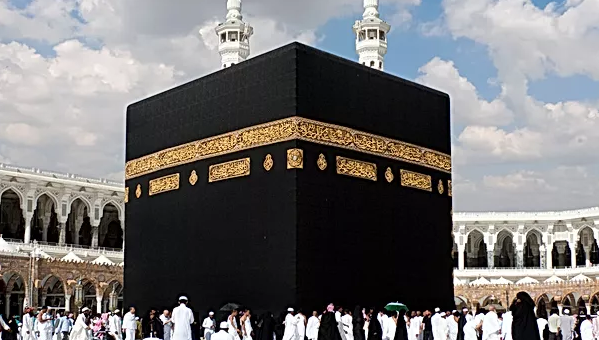
The Kaaba is the central and most sacred structure in Islam, located at the heart of the Al-Masjid al-Haram (the Grand Mosque) in Mecca. This cube-shaped building symbolizes monotheism and serves as the qibla — the direction of prayer — for all Muslims around the world.
Location
Country: Saudi Arabia
City: Mecca
Site: In the inner courtyard of Al-Masjid al-Haram
Historical Background
Date of origin: According to Islamic tradition, the Kaaba was built by the Prophet Ibrahim (Abraham) and his son Ismail (Ishmael) by the command of Allah.
History:
- The original Kaaba was a wooden structure and has been rebuilt and renovated many times throughout history.
- It has undergone several destructions and restorations.
- The current building is covered with a black silk and gold-embroidered cloth known as the Kiswah, which is replaced annually.
Key Events:
- Various reconstructions throughout history, including during the time of the Prophet Muhammad ﷺ.
- Damages caused by fires and floods.
- The Kaaba is central to the Islamic pilgrimage rituals of Hajj and Umrah.
Architecture and Features
- Shape: Cube (approximately 13.1 m long, 11.03 m wide, and 12.86 m high).
- Material: Limestone walls covered with the black Kiswah embroidered in gold.
- Entrance: The raised doorway is located on the eastern side.
- Corners of the Kaaba: Four corners, each with a specific name (e.g., Rukn al-Yamani - “the Yemeni corner,” Rukn ash-Shamali — “the northern corner”).
Sacred Elements:
- The Black Stone (Hajar al-Aswad): Embedded in the eastern corner, it is revered as a holy relic.
- The interior of the Kaaba is empty, containing a few pillars supporting the roof.
Religious Significance
- The Kaaba is considered the “House of Allah” on Earth, the focal point of Islamic worship, and a symbol of unity among Muslims worldwide.
- It is the qibla — the direction Muslims face during their prayers (salah).
- It is the central site of pilgrimage (Hajj), one of the Five Pillars of Islam.
- Performing the circumambulation (tawaf) around the Kaaba is an essential ritual of both Hajj and Umrah.
Cultural and Touristic Importance
- Every year, millions of pilgrims perform tawaf around the Kaaba during Hajj and Umrah.
- It serves as a symbol of unity and spiritual connection among Muslims of diverse nations and cultures.
- It is admired not only as a religious center but also as a monument of profound historical and architectural significance.
Current Status
- The Kaaba is under continuous protection and maintenance by the authorities of Saudi Arabia.
- The Kiswah is replaced annually in a special ceremony.
- Both the interior and exterior structures are regularly maintained and restored as needed.
- Access to the interior is restricted and granted only to a limited number of individuals.